National Discourse on First-Year Mathematics
The national discourse on first-year college mathematics has shifted from "Who belongs in college math?" to "How do we design college math so that everyone can succeed?" By aligning curriculum with career goals, implementing active pedagogy, and replacing remedial structures with co-requisite models, higher education is systematically dismantling its greatest gatekeeper.
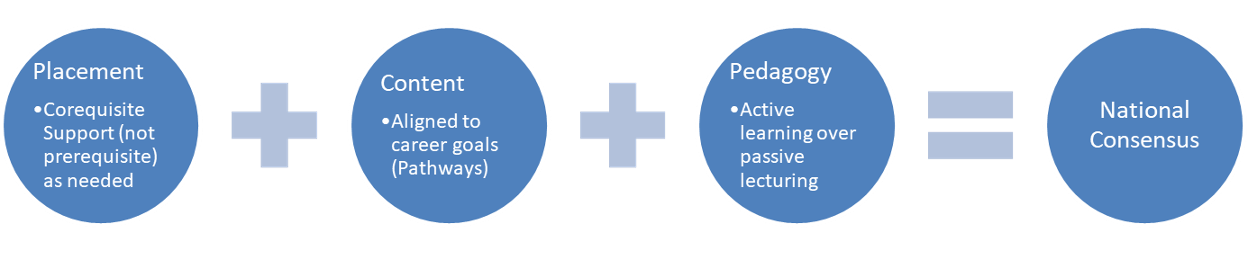
A United Front from National Organizations
The Philosophical Blueprint: AMATYC’s Crossroads
The intellectual foundation of modern mathematics reform traces back to the American Mathematical Association of Two-Year Colleges (AMATYC) and its landmark 1995 publication, Crossroads in Mathematics: Standards for Introductory College Mathematics Before Calculus.
Crossroads established a paradigm shift away from rote memorization and mechanical manipulation, rooted in the following core principles:
- Relevance and Real-World Context: Mathematics should be introduced through meaningful, real-world problem-solving situations, allowing students to grasp the "reasonableness" and utility of the discipline. This is at the root of the “Math Pathways” movement described below.
- Active Learning and Pedagogy: Instruction must shift from passive lecturing to a "laboratory discipline" featuring active student participation, collaborative learning, and hands-on investigation using genuine data.
- Balanced Technology Integration: Technology—including graphing utilities and spreadsheets—must be used as an essential learning tool to help students visualize and explore concepts rather than just calculate.
These principles have formed the bedrock of much of collegiate math reform since then, including most recently through the Transforming Post-Secondary Education in Mathematics (TPSE Math) Modernizing Undergraduate Mathematics work. They are advocating for integrating data reasoning, computational sensemaking, and mathematical modeling directly into first-year courses, ensuring every student—STEM or non-STEM—develops quantitative literacy.
Ensuring Relevance: Math Pathways
Numerous organizations have released research and recommendations related to the implementation of Math Pathways, including the Carnegie Foundation, Charles A. Dana Center at UT Austin, AMATYC, MAA, AMS, SIAM, ASA, Community College Research Center, and most recently Complete College America (CCA). In their recent Formula for Success: How to Support Every Student Through Math Pathways (2025), CCA released their Math Pathways 2.0 framework which recommended the following five pathways:

Addressing the Affective Domain: Cultivating Productive Persistence
Based on more than a decade of research, including a 2019 report by Center for Community College Student Engagement, Carnegie and West Ed have developed a framework of the key non-cognitive factors that positively impact their course persistence and success by helping them with their self-confidence, sense of belonging, and math anxiety. Their framework is freely available, and many of the principles within are echoed by the other organizations listed above.
First-Year Mathematics Outside of Georgia
The shift toward Math Pathways has led to creative, rigorous, and applicable first-year mathematics courses designed for students whose careers do not require traditional calculus.
Four such courses that differ from the current options used in Georgia are listed below. Note this list is not intended to be an endorsement for these specific courses but rather are illustrative of alternative options.
- Mathematics of Decision Making: An exploration of mathematics applied to voting systems, fair division, game theory, and network analysis. It addresses the mathematical paradoxes of democracy, such as how different voting systems yield different winners from the exact same ballots. Taught At: University of Alabama at Birmingham (MA 108: Mathematics of Social Choice) and Clemson University (MATH 1010: Essential Mathematics for the Informed Society). A version of this course is also available as a fourth-year math course in Georgia’s high schools. UGA teaches this course.
- The Mathematics of Codes and Cryptography: Investigates the mathematical mechanisms used to secure information historically and in the digital age. Students explore the history of codebreaking (such as the Enigma machine) using elementary number theory, prime numbers, modular arithmetic, and basic encryption algorithms. Taught At: George Mason University (MATH 175: Mathematics of Cryptography: An Introduction) and University of Maryland-College Park (MATH 107: Introduction to Cryptography).
- Mathematics in Art, Nature, and Design: Examines the visual and aesthetic connections between mathematical formulas and the physical world. Focus areas include the Golden Ratio, Fibonacci sequences, symmetry groups, fractals, tessellations, and the geometry of perspective drawing. Taught At: Indiana University-Bloomington (MATH-M 106: Mathematics of Decision and Beauty) and University of Colorado Boulder (MATH 1130: Mathematics from the Visual Arts).
- Finite Mathematics: A broad survey of applied mathematical structures designed specifically for non-STEM students. Standard topics include set theory, symbolic logic, systems of linear equations, basic probability, financial mathematics, and linear programming (optimization problems). Taught At: University of South Alabama (MA 110: Finite Mathematics) and Missouri Western State University (MAT 112: Finite Mathematics).
ReImagining Team
Contact Us
Aimee Berger
aimee.berger@usg.edu
Duane Day
duane.day@usg.edu
Jonathan Watts Hull
jonathan.hull@usg.edu
Melanie Largin
melanie.largin@usg.edu
Laura Lynch
laura.lynch@usg.edu
Jennifer Palmer
jennifer.palmer@usg.edu